We specialize in helping small service businesses keep accurate books and use data analysis tools like the biggest companies in the room — so you can focus on running yours.
We offer a range of bookkeeping services to cover your company's accounting needs — monthly, annually, or as a one-time project to get you on the right track.
What is it? The process of grouping similar transactions into categories called accounts.
How does it benefit you? Categorization helps to track the flow of money in and out of your company. It's also needed for tax preparation.
What is it? The comparison of the transactions recorded in the accounting software with those included on the bank or credit card statements.
How does it benefit you? Reconciliation ensures the accuracy and completeness of your financial records. This process also helps to prevent errors like over or undercounting sales and expenses, both of which can directly impact your taxes.
What is it? There are three primary financial reports:
The Profit and Loss Statement (also called an Income Statement) shows how much money you made.
The Balance Sheet shows how much you own and how much you owe to others.
The Statement of Cash Flows shows how much cash you have available.
How does it benefit you? The reports are like a financial health snapshot. They help you gauge what's going well and where there's room for improvement. These reports are also often requested by lenders or investors.
What is it? Accounts Payable is for money that you owe to vendors. Accounts Receivable is for money that customers owe to you.
How does it benefit you? Managing AP well helps to maintain good credit terms and working relationships with your vendors by paying on time, while controlling your cash flow. Managing AR well helps to maintain a steady flow of payments from customers.
All tiers include a monthly summary with selected financial statements and direct communication with your bookkeeper. Custom packages are always available.
| Service Tier | Max Transactions/mo | Max Accounts to Reconcile |
|---|---|---|
| Start | 100 | 4 |
| Grow | 200 | 7 |
| Thrive | 400 | 10 |
| Expand | Custom | Custom |
Good bookkeeping is the foundation — but real growth comes from understanding what the numbers are telling you. We bring enterprise-level financial analysis tools to small businesses.
The comparison of the estimated costs of the project bid with the actual amounts spent. Costs can be analyzed per project and even for subcategories within projects.
Benefit Knowing which sections of the project were over or under budget can help to refine your bids and boost profitability.
Ratios are calculated based on the financial data from a given period. The most useful include profitability, leverage, and liquidity ratios. We look for patterns and trends to quantify your success and detect areas for improvement.
Benefit A measurable way to compare your business performance over time or benchmark against others in the same industry.
Financial data can be presented in a variety of ways. Dashboards provide a visual summary of your data — the amount and type of information is fully customizable based on your business needs and preferred learning style.
Benefit Data is most helpful when presented in a format that's effective for your team. We'll work together to select the right format and frequency for analysis.
Certified, educated, and continuously trained to serve your business with the highest standards.
Hi! I'm the founder of Stand Out Bookkeeping. I started this practice because I believe every small business deserves access to the financial clarity that larger companies take for granted.
I work closely with service business owners — contractors, consultants, agencies, and more — to build clean books, deliver meaningful reports, and help you make confident decisions with your money.
When you work with Stand Out Bookkeeping, you get a dedicated partner who knows your business by name, not just by account number.
Certified, educated, and continuously trained to serve your business with the highest standards.


Your bookkeeper and your CPA work together but have different roles. Your bookkeeper records and categorizes your transactions and prepares financial statements. Here at Stand Out, we also offer financial analysis services. Your CPA is your tax specialist — they help with tax preparation, filing, and financial advice.
Not at all. Compliance is just one facet of bookkeeping. Accurately recording your transactions is crucial for filing taxes — but that's only the beginning. There's also a forward-looking component: financial data can help you prepare a budget, plan for large expenses, and create a short-term cash flow forecast.
Reconciliation ensures accuracy by comparing the transactions recorded in your accounting software with your bank and credit card statements. The first step of any valuable analysis is confirming the quality of the data. Reconciliation gives you the confidence that your numbers are reliable.
The main difference is timing. With cash basis, you record the transaction when money comes in or goes out. With accrual basis, you record revenue when it's earned (e.g. you send an invoice) and expenses when they're incurred (e.g. you receive a bill from a vendor).
There are three primary financial reports. The Profit & Loss Statement shows how much money you made. The Balance Sheet shows how much you own and owe. The Statement of Cash Flows shows how much cash you have available. Together they act as a financial health snapshot — lenders and investors often request these as well.
Key categories include: gross receipts, purchases, business expenses, travel and entertainment expenses, assets, and employment taxes.
Stand Out Bookkeeping LLC does not provide tax advice. Please consult your CPA.
Your bookkeeper might handle most of the workflow in QuickBooks — but it's vital for business owners to stay informed. If you have a high-level understanding of what the financial data tells you about your business, then it becomes a valuable tool that can help you understand your cash flow, make strategic decisions, and avoid over or underpaying your taxes.
Definition: Items you own that benefit the business.
e.g. Bank accounts, Machinery, Vehicles
Definition: Money that you owe to others.
e.g. Credit cards, Vendors paid on credit, Loans
Definition: The net worth of the company — the value left when liabilities are subtracted from assets. Also where money invested in or taken out of the business is recorded.
e.g. Retained earnings, Owner's equity
Definition: Amounts received for a good or service.
e.g. Sales to customers, Services, Other income
Definition: Amounts paid to operate the business.
e.g. Wages, Supplies & materials, Cost of Goods Sold
Money owed to the company by customers.
Money that the company owes to vendors.
Managing AP well helps maintain good credit terms and working relationships with vendors by paying on time, while controlling your cash flow. Managing AR well helps maintain a steady flow of payments from customers.
Expenses related directly to producing the good or providing the service.
Money received from customers for goods or services provided.
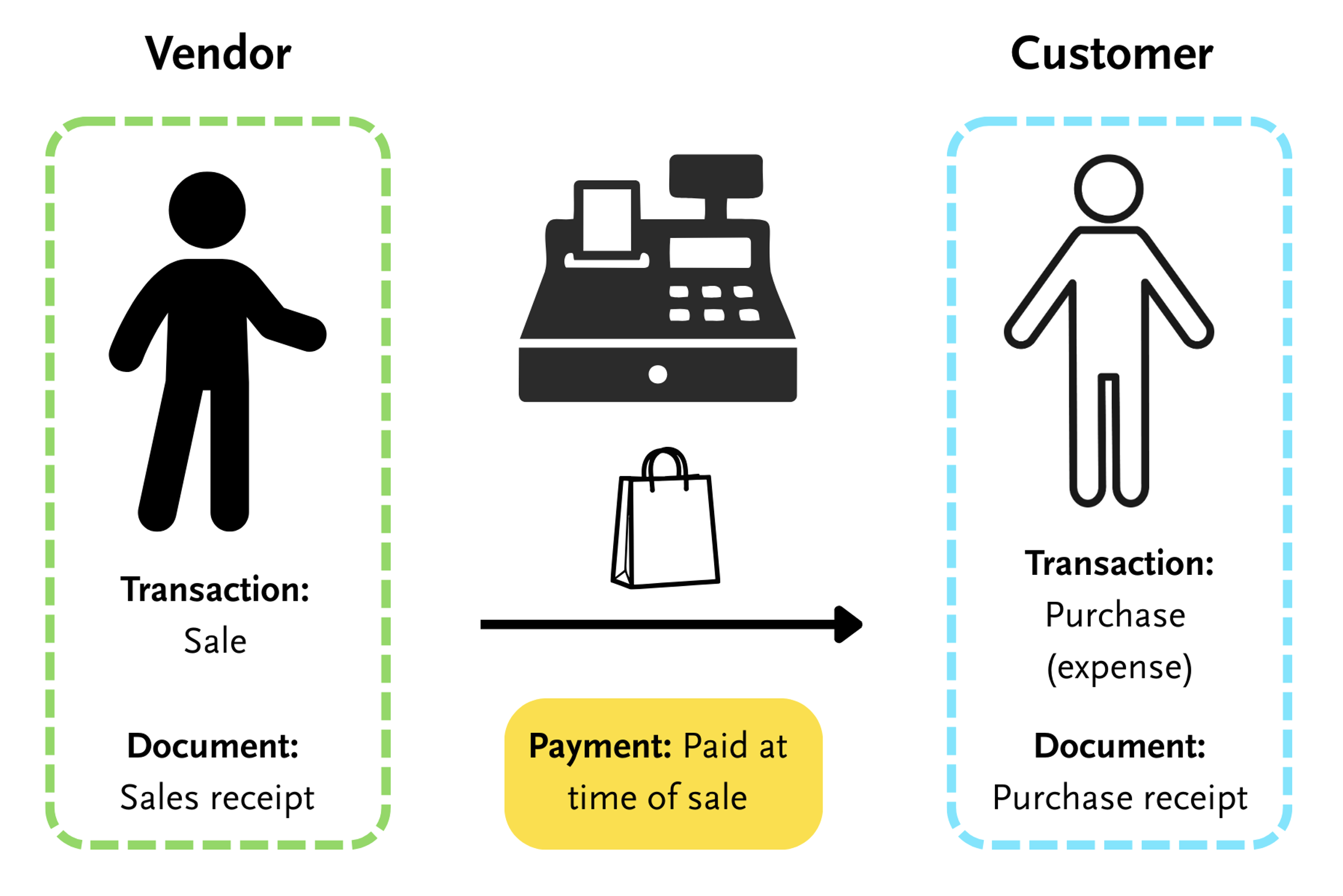
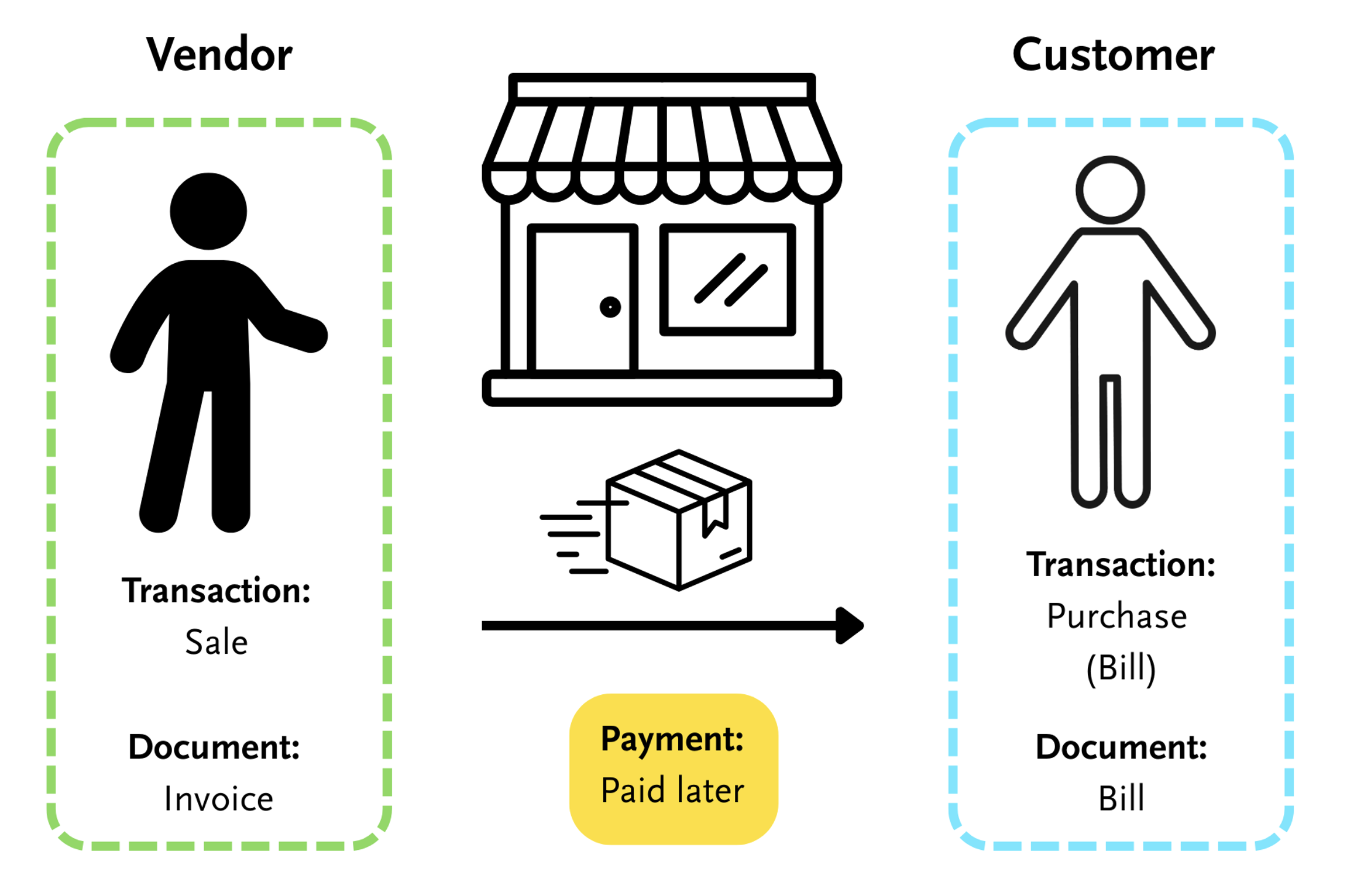
Whether something is a sale or a purchase depends on your viewpoint. In any transaction there are two parties. The vendor makes a sale and the customer makes a purchase — it's the same transaction, just seen from opposite sides.
Both a bill and an expense represent money your company will pay — but the difference is timing. A bill means you received the goods or service but will pay later (you receive an invoice from the vendor). An expense means you received the goods or service and paid at the same time (you receive a sales receipt).
As for bill vs. invoice — it's the same document, just a matter of viewpoint. The vendor sends the invoice. The customer receives the bill.
The same transactions are being recorded — the difference is timing. With cash basis, you record the transaction when the money comes in or goes out. With accrual basis, you record the transaction when the revenue is earned or the expense is incurred — regardless of when cash actually changes hands.
Book a free introductory call on our calendar or reach out directly. We'd love to learn about your business.
Book a Free Call →